
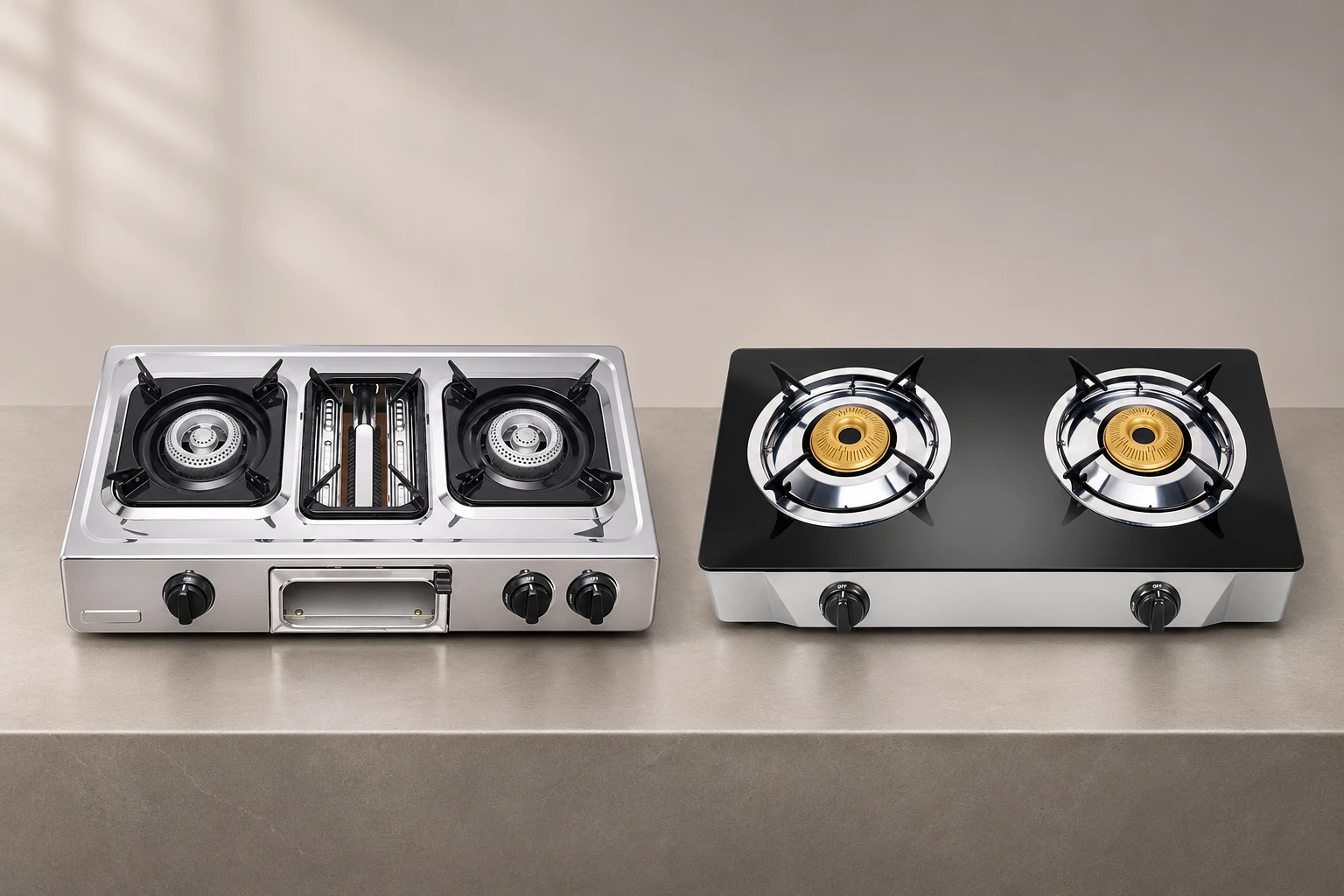
For importers comparing glass and stainless steel gas cookers, panel material affects appearance, cleaning, handling, and quality control. Tempered glass offers a smooth, contemporary surface and requires care around impacts, edges, and temperature changes. Stainless steel offers a conventional metal finish, with surface wear, corrosion resistance, and cleaning results dependent on its grade and finish.
Choose the material around your target customer and price position. Evaluate it alongside the cooker’s burner and grate design, gas configuration, installation requirements, documentation, packaging, and replacement-part support. Confirm the complete model’s suitability for the intended U.S. sales channel.
Choose panel material around the intended product range
Start with how the cooker will be sold and used. A glass panel may fit a range positioned around a smooth, modern appearance. A stainless steel panel may suit buyers who prefer a familiar metal finish and whose distribution process is arranged around metal-panel handling.
Both options can work in a commercial product range. Purchasing and after-sales teams should evaluate the following differences.
| Sourcing factor | Tempered glass panel | Stainless steel panel |
|---|---|---|
| Appearance | Smooth, reflective surface with a look shaped by color and edge treatment | Metal appearance varies with finish, grain, and fabrication |
| Routine cleaning | Smooth exposed areas can be wiped, but residue and marks may show | Wipes clean, but fingerprints, streaks, and scratches may be visible |
| Handling concern | Impacts, chipped edges, and inappropriate thermal exposure warrant attention | Scratches, dents, and surface deformation warrant attention |
| Key specification request | Glass construction, thickness, edge treatment, and care instructions | Steel grade, thickness, finish, and care instructions |
| Receiving priority | Inspect surfaces and edges for chips, cracks, and transit damage | Inspect for dents, scratches, finish consistency, and transit damage |
Panel construction, support, burner layout, packaging, and quality control affect how these material considerations apply to a particular cooker.
A mixed range may be appropriate if your customers have different style preferences. If you carry both materials, avoid assuming that the same cleaning instructions, packaging checks, or replacement-part procedures apply to each.
Compare appearance and cleaning requirements
A glass cooktop can present a clean, uniform surface, especially where there are few seams around the burners. Stainless steel can provide a more industrial or professional-looking finish. Grease, food residue, water marks, and fingerprints can be visible on either material, so sample reviews should include surface-care requirements.
When reviewing samples, look beyond the panel’s center. Check the areas around burner openings, controls, grates, seams, and any drip tray. Components that lift off or are easy to reach can affect cleaning time as much as the panel material.
Apply the manufacturer’s instructions to the cleaning review for either surface.
- Let the cooker cool before cleaning, and follow the model-specific instructions.
- Remove spills with the cleaning products and tools approved by the manufacturer.
- Avoid abrasive pads or harsh chemicals unless the instructions explicitly permit them.
- Check whether grates, burner parts, and drip trays can be removed for routine cleaning, and how they must be reassembled.
For a private-label program, request the proposed user-care instructions before approving artwork or manuals. A surface that looks attractive in a showroom may be a poor fit if its permitted cleaning method does not match customer expectations.
Understand glass handling and surface-care limitations
Tempered glass is processed for strength. Its handling requirements still need to account for edge impacts, existing chips, concentrated loads, and unsuitable temperature exposure. Review the panel’s design and support to understand how the assembled cooker is intended to perform.
Ask the supplier to identify the panel construction, glass thickness, edge treatment, and approved cleaning method. Request instructions for handling, installation, and use, including any restrictions concerning cookware or exposure to temperature changes. Do not assume every glass cooker has the same limitations.
For incoming inspection, examine the panel face and exposed edges under good lighting. Record chips, cracks, deep scratches, or movement that appears inconsistent with the approved sample. Set aside damaged units rather than installing or selling them, and agree on a reporting and disposition process with the supplier.
Also clarify what happens if a panel is damaged after sale. Ask whether a replacement panel or complete assembly is available, who may perform the repair, and whether the design allows that repair. These answers can influence the real cost of carrying a glass-panel range.
Request stainless steel grade and finish details
Stainless steel grades have different material properties. Grade, thickness, finish, and the surrounding construction all matter when specifying a cooker panel. A brushed surface can show wear differently from a polished surface, while visible grain and color can vary between samples or production lots.
Include these points in your supplier request.
- Identify the grade and nominal thickness of the panel material and ask how the supplier verifies them.
- Specify the intended finish, grain direction where applicable, and acceptable variation.
- Review fabrication at exposed edges, joints, burner openings, and areas where residue could collect.
- Confirm surface-care instructions, including recommended cleaners and restrictions on tools or chemicals.
- Agree on inspection criteria for scratches, dents, marks, and other visible defects.
Do not infer the grade from color or a product photograph. If corrosion resistance is important to your intended use and cleaning environment, discuss that use with the supplier and request appropriate material information and supporting evidence.
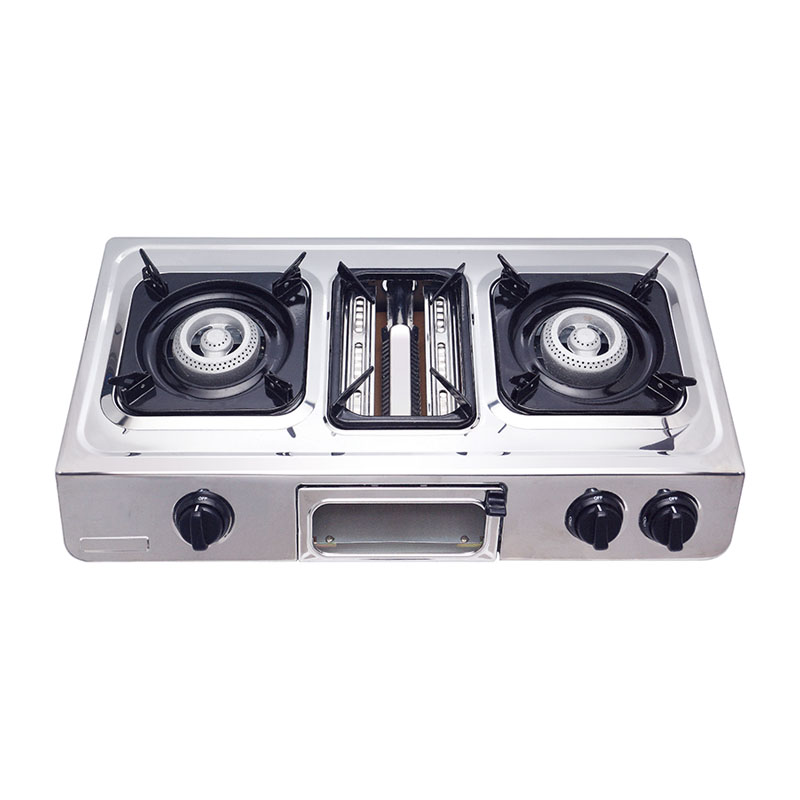
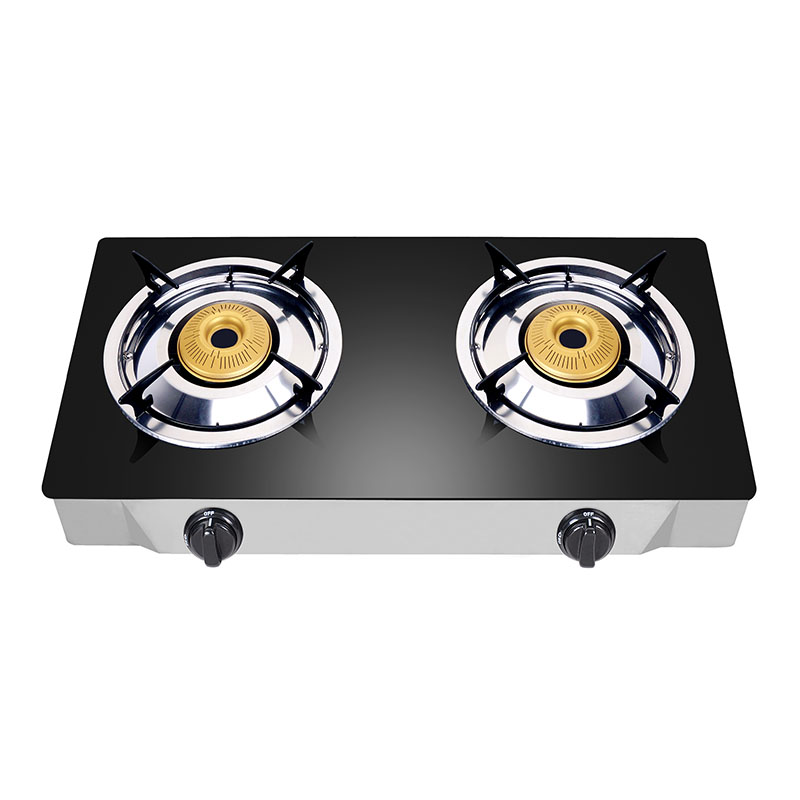
Compare JHL.2-T027 and JHL.2-T055C listed features
The following Jinhuali product records show how panel material fits into a broader comparison of listed features. Review the complete specifications for each model under consideration.
| Listed attribute | JHL.2-T027 stainless steel panel cooker | JHL.2-T055C tempered glass panel cooker |
|---|---|---|
| Panel | Stainless steel | Tempered glass |
| Ignition | Auto ignition | Auto ignition |
| Pan grate | Not specified in the supplied listing details | Enameled pan grate |
| Drip tray | Not specified in the supplied listing details | Stainless steel drip tray |
| Listed body dimensions | 700 × 395 × 110 mm | Not specified in the supplied listing details |
The supplied details do not state the steel grade for JHL.2-T027 or the glass thickness for JHL.2-T055C. They also do not establish that either model is built in or includes flame-failure protection.
Before comparing landed offers, request complete, current specifications for both models. The glass panel and stainless steel drip tray have separate material and care requirements. Grates, burner parts, controls, and the body also affect cleaning and service expectations.
Confirm installation type and gas configuration
Panel material does not tell you whether a cooker is freestanding, countertop, or designed for built-in installation. It also does not identify the gas for which the unit is configured. Confirm those details for each model and intended destination before approving packaging, product listings, or an order.
Address the following details in the configuration request.
- Installation type and clearances. Obtain the intended installation method, required clearances, ventilation guidance, and installation instructions. Do not use body dimensions alone to calculate a cutout or assume built-in suitability.
- Gas configuration. Confirm the intended gas supply, applicable inlet pressure, connection requirements, and whether any conversion is permitted. Request the correct instructions and components for the configuration being supplied.
- Ignition and power. Verify how auto ignition is powered and any electrical or battery requirements for the exact model.
- Safety features. Ask specifically whether flame-failure protection or other required features are included and request the corresponding model documentation.
- Destination-market documentation. Identify the intended U.S. sales channel and installation context, then request applicable safety documentation, test reports, markings, and instructions for the exact model and configuration.
Have a qualified compliance professional or other appropriate specialist assess what applies to your product and market. Supplier documents should match the product being ordered, including its model identification and relevant configuration. Ask about any differences between a submitted sample and the planned production unit.
Review packaging and sample inspection priorities
A cooker that arrives with a cracked panel or damaged finish creates costs before it reaches a customer. Review the product and its packaging together, especially when changing panel materials or shipping configurations.
Use a preproduction or approval sample to complete the following review.
- Compare against the specification. Check the model identification, panel material, stated dimensions, ignition arrangement, included parts, and documentation.
- Inspect the complete assembly. Look for loose components, uneven fit, sharp exposed edges, damaged controls, and inconsistencies in visible surfaces.
- Check material-specific damage. Inspect glass faces and edges for chips or cracks. Inspect stainless steel for dents, scratches, and finish variation.
- Review the pack. Check how the cooker is supported and protected against movement, contact, and pressure during handling. Confirm that accessories and documentation are secured.
- Agree on acceptance criteria. Define which cosmetic and functional issues are acceptable, how defects will be recorded, and what corrective action is expected.
- Plan appropriate verification. Discuss packaging evaluation and product testing for the expected distribution conditions with the supplier or a qualified testing provider.
An undamaged sample does not prove every shipment will arrive undamaged. Keep an approved reference sample and agreed inspection criteria so receiving teams can compare future deliveries consistently.
Create a cooker sourcing specification
Turn the comparison into a written specification before requesting final quotations. This makes it easier to compare offers on the same basis and reduces the risk of approving a panel material while leaving critical configuration details unresolved.
Include the following requirements in the written specification.
- Define the commercial scope through the model number, intended destination market, sales channel, branding, quantities, and requested terms.
- Describe the panel requirements, including glass construction and thickness or steel grade and thickness, finish, color where relevant, edge treatment, and acceptable cosmetic variation.
- Specify the other visible components, including grate, drip tray, controls, body finish, and parts that must match an approved sample.
- Record the configuration, including installation type, gas supply and pressure, connection details, ignition power, and required safety features.
- Request the documentation, including current specifications, installation and care instructions, parts information, and applicable destination-market safety documents.
- Agree on quality and packing requirements, including sample approval, inspection criteria, packaging, shipping marks, and damage-reporting procedures.
- Confirm after-sales support for spare parts, repair guidance, defects, and transit damage.
Review the Jinhuali gas cooker range against your specification, including the two models compared above. For model-specific questions, contact Jinhuali with the model numbers, destination market, and required installation and gas configuration.