
Start a range hood buying decision with the cooking area and the planned ventilation path. Establish the hood format and width, determine whether the installation can exhaust outdoors, and check the outlet and duct route before comparing catalogue airflow figures.
For importers, a useful specification also covers electrical compatibility, filters, noise data, documentation, packaging, and replacement parts. This range hood buying guide for importers explains how to evaluate those details and turn them into a practical sample and quotation request.
Define the kitchen layout and hood format
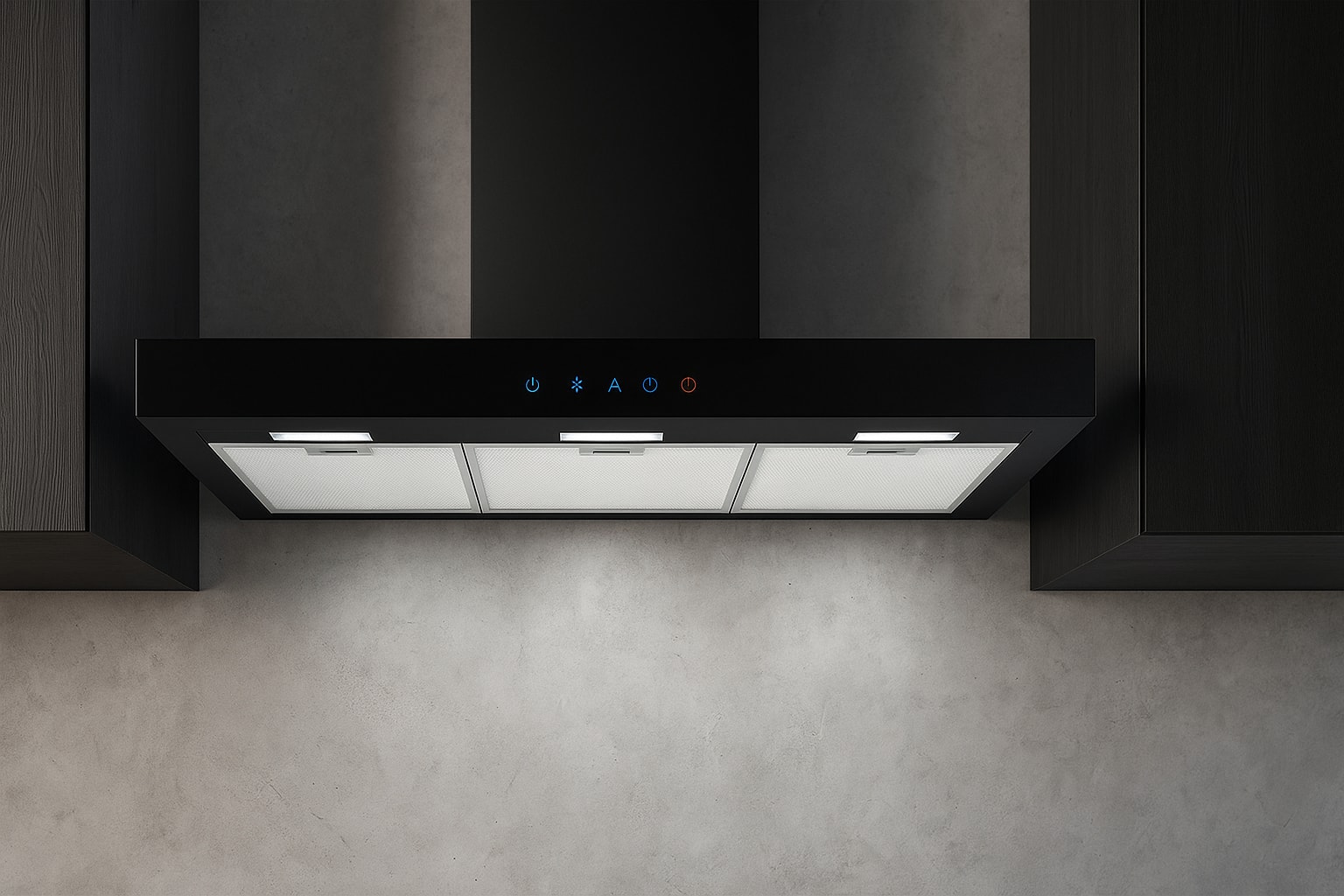
Select a hood format that fits the intended kitchen installation. A wall-mounted hood, under-cabinet hood, island hood, and built-in insert have different space, support, and duct-routing requirements. Confirm the proposed format in the documentation for each model.
Document the intended installation before requesting a quotation.
- Record the cooking appliance’s overall width, cooking-zone layout, and intended residential or other use.
- Describe the available space, including cabinet dimensions, ceiling height, wall obstructions, and limits on the hood’s projection.
- Identify an available ventilation path and where an outdoor exhaust duct could pass.
- Record installation constraints, including the mounting surface, electrical supply, and building-specific requirements.
- Define the target customer, such as a specific kitchen project, retail inventory, or a private-label product range.
Outdoor exhaust carries air through a duct to the exterior, while recirculation filters the air and returns it to the room. If recirculation is required, ask whether the specific model supports it, what accessories are needed, which are included, and whether replacement filters will be available.
Compare hood width with the proposed cooking area
Compare the hood’s listed width with the cooking appliance and the area that produces smoke, steam, and grease. A hood that is too narrow for the intended layout may not cover the full cooking area effectively, even if its catalog airflow looks attractive.
For a wholesale assortment, group likely applications by cooking-appliance width and installation format. Then request dimensional drawings for the candidate hoods. A nominal width is useful for an initial comparison, but it does not show the exact cabinet fit, capture area, mounting points, or space needed for the duct and electrical connection.
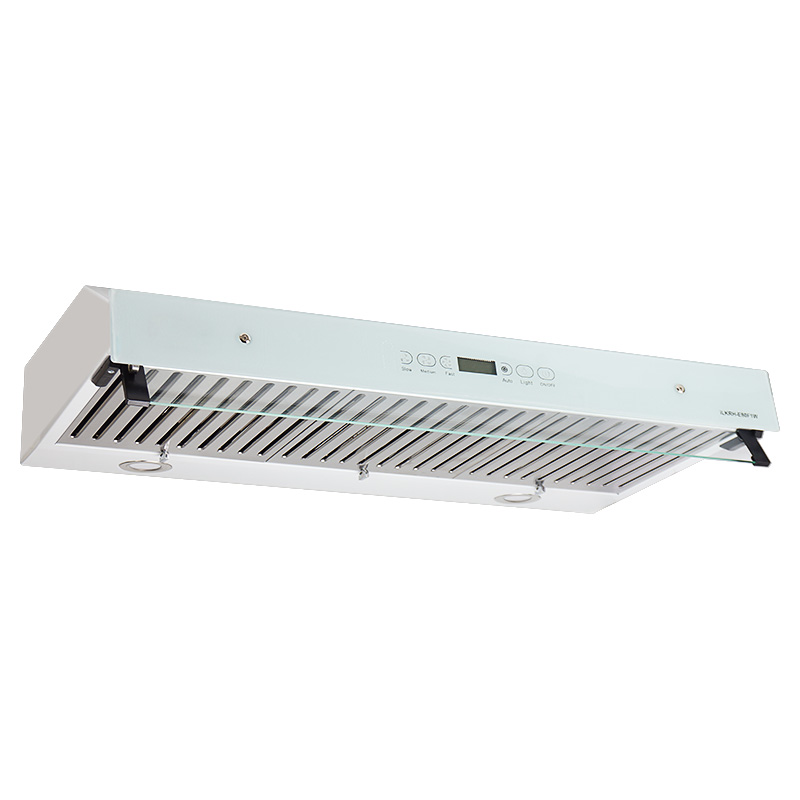
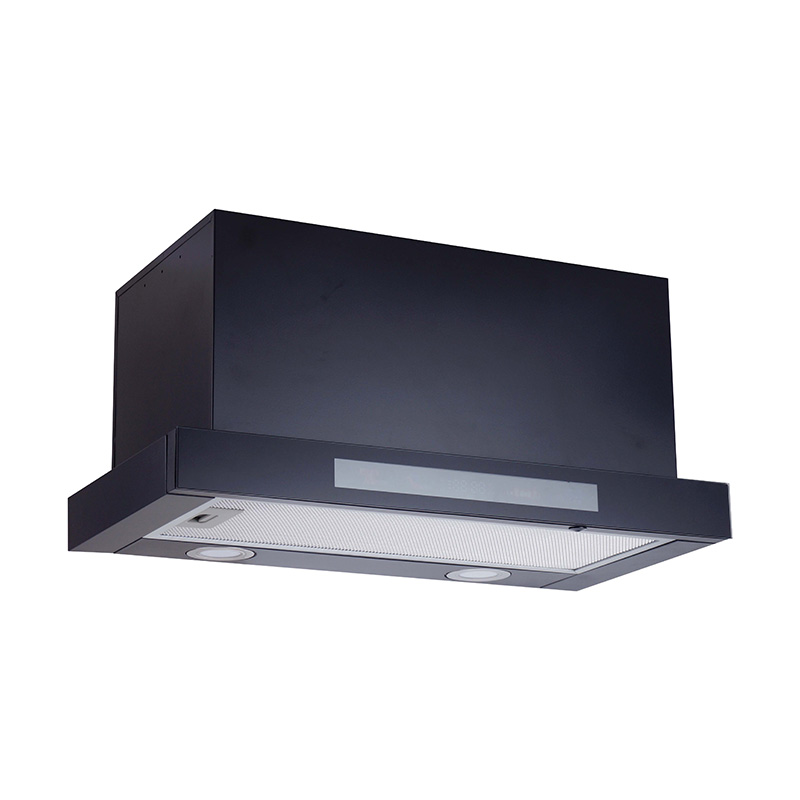
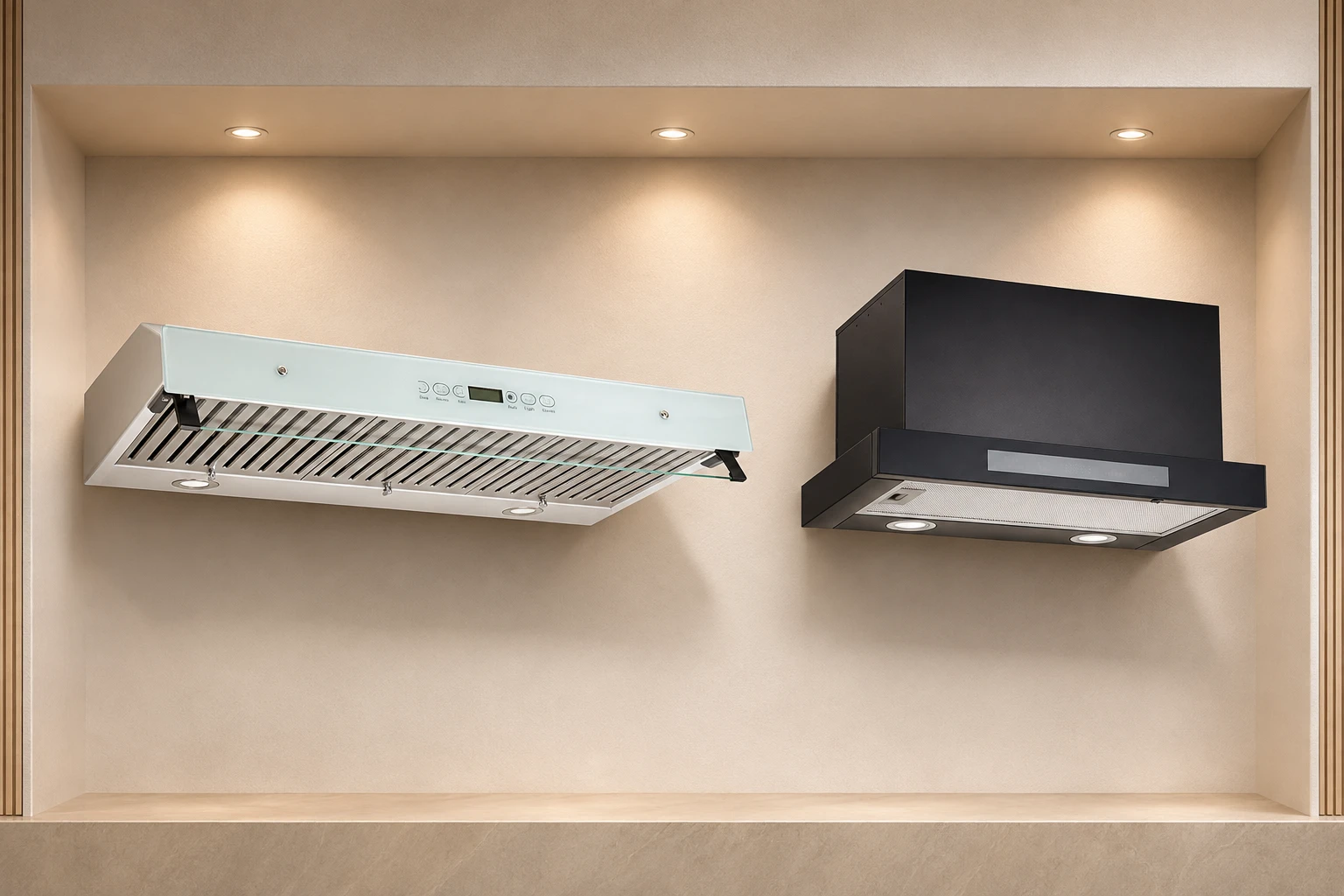
The two Jinhuali models compared below have different widths and the same stated catalog airflow. One is listed at 900 mm and the other at 600 mm. Assess each width against the intended cooking area and installation instructions when deciding which model to investigate.
For U.S. planning, approximate conversions can make a shortlist easier to discuss. The listed widths of 900 mm and 600 mm are about 35.4 inches and 23.6 inches respectively. Use the supplier’s exact dimensional drawing to verify fit.
Read catalog airflow alongside ducting requirements
Catalog airflow provides an initial comparison point. Installed airflow depends on the complete ventilation system, including duct length, bends, restrictions, termination, and the conditions under which the manufacturer measured the catalog figure.
Both models in the comparison list airflow at 700 cubic meters per hour, approximately 412 cubic feet per minute (CFM). That conversion helps U.S. buyers read the figure, but it does not establish installed CFM or prove that the models will perform identically.
Request supporting information when reviewing an airflow claim.
- The measurement method and test conditions, including whether the figure represents unrestricted airflow or a result measured against resistance.
- Airflow at relevant operating speeds, if available, rather than only the maximum catalog number.
- Performance information at different static pressures, if available, so the figure can be considered alongside the planned duct system.
- The model configuration tested, including motor, filters, and any accessories that affect airflow.
- The applicable installation instructions, including duct requirements and limitations.
Avoid comparing a maximum airflow figure from one supplier with a differently measured figure from another as though they were equivalent. Also consider local code and the requirements of the specific project, including whether makeup air is required. Those decisions depend on the installation and should be checked with the appropriate local authority or qualified installer.
Check outlet size and the planned exhaust route
Include outlet size in the duct specification review. Both models below list a 150 mm air outlet, approximately 5.9 inches. Ask for the exact outlet dimensions, connection details, and installation requirements before specifying duct components.
Map the route from the hood to the exterior early in the buying process. Consider where the duct can travel, how many directional changes are unavoidable, and whether structural elements or cabinets limit the available space. Longer or more restrictive routes can affect performance, so a route that looks convenient on a floor plan still needs technical review.
Resolve these connection details before approving a model.
- Whether the stated outlet dimension refers to the required duct connection and whether an adapter is included.
- The permitted duct sizes, materials, and route configurations in the model’s instructions.
- Whether the planned exterior termination is compatible with the installation.
- Whether any dampers or other components are supplied or must be sourced separately.
- Whether the proposed installation meets applicable local requirements.
Do not reduce the duct size simply to fit an existing opening without checking the manufacturer’s instructions and the project requirements. An adapter may physically connect two sizes without making the resulting system appropriate.
Compare JHL-SH003 and JHL-TS001 listed features
The following comparison uses the supplied Jinhuali catalog details. Confirm current specifications and the intended configuration before ordering.
| Attribute | JHL-SH003 model record | JHL-TS001 model record |
|---|---|---|
| Listed width | 900 mm, approximately 35.4 in. | 600 mm, approximately 23.6 in. |
| Air outlet | 150 mm, approximately 5.9 in. | 150 mm, approximately 5.9 in. |
| Catalog airflow | 700 m³/h, approximately 412 CFM | 700 m³/h, approximately 412 CFM |
| Lighting | LED | LED |
| Controls | Touch controls | Touch controls |
| Filters | Two stainless steel filters | Two aluminum filters |
The most immediate shortlist distinction is width. The filters also use different listed materials, but material alone does not establish cleaning frequency, dishwasher suitability, filtration performance, or replacement cost. Ask for maintenance instructions and replacement-part details for each model.
The available information does not establish either model’s noise level, recirculation accessories, installation format, electrical specification, or suitability for a particular market. Request those details for the exact model and configuration. The shared catalog airflow figure should not be treated as an installed-performance result.
Request noise data and filter maintenance information
Request comparable noise data before placing a production order. A single sound figure without a speed setting or test method is difficult to interpret, and noise perceived in a kitchen can differ from a laboratory result.
Ask for noise measurements at each available fan speed, the units used, the test method, and the configuration tested. If comparing suppliers, check whether the measurements were taken under comparable conditions. Listen to the sample in an appropriate test setup as well, while recognizing that the duct and room can affect the result.
Request the maintenance and replacement information for each filter.
- Removal and reinstallation instructions.
- Recommended cleaning method and maintenance interval.
- Whether the supplied filters are dishwasher-safe.
- Replacement filter part numbers, pricing, and ordering arrangements.
- Whether optional filters are required for any supported recirculation configuration.
- Availability and identification of other service parts.
These details matter to retailers and private-label brands because customer instructions and after-sales support need to match the product actually shipped. Do not advertise a filter as washable, dishwasher-safe, or suitable for recirculation until the supplier confirms it for that model.
Confirm market documentation and packaging requirements
For the United States, identify the documentation and product markings required for the intended sales channel and installation before approving a sample. Requirements can depend on the product configuration, destination, applicable codes, and retailer or distributor requirements. A listing in a catalog is not proof that a model meets them.
Ask the supplier for current documentation covering the exact model, electrical configuration, and destination market. Review the applicable product safety, electrical, electromagnetic compatibility, labeling, and installation requirements with a qualified compliance specialist or testing organization as appropriate. Verify any claimed certification or listing against the relevant issuing organization and the actual model designation.
Confirm the electrical and packaging details as part of the same review.
- Rated voltage, frequency, plug or wiring arrangement, and electrical documentation.
- Required labels, model identification, warnings, and English-language instructions.
- Whether private-label branding changes documentation, labeling, or approval responsibilities.
- Carton dimensions, gross and net weight, packing configuration, and pallet details.
- Protection for finished surfaces, glass if applicable, filters, controls, and duct outlets.
- Spare-part packaging and any required retail or shipping labels.
For quotations, specify the destination, order quantity, packaging configuration, and requested trade terms. Ask the supplier to identify what is included and what is quoted separately. This prevents an apparently comparable unit price from concealing differences in accessories, documentation, or packing.
Prepare a range hood sample and quotation checklist
Build a shortlist around the application first, then use the Jinhuali range hood category to identify candidate records for further review. Prepare the purchase specification from confirmed details for the exact model.
Send each shortlisted supplier the same requirements to make responses comparable.
- Describe the application and format, including intended customer, cooking-appliance width, mounting format, and available space.
- Specify the ventilation configuration, including outdoor exhaust or confirmed recirculation, proposed duct route, outlet connection, and accessories.
- Request performance evidence for airflow test conditions, available static-pressure information, operating speeds, and noise.
- Confirm product details for exact dimensions, electrical rating, controls, lighting, filter construction, and included components.
- Define maintenance requirements for cleaning instructions, consumables, replacement parts, and after-sales arrangements.
- Request market documentation covering applicable reports, listings or certifications, labels, and installation and user instructions.
- Provide commercial details for quantity, private-label requirements, packaging, trade terms, samples, and the production quotation.
When the sample arrives, check its dimensions and included components against the approved specification. Examine finish quality, controls, lighting, filter removal, markings, instructions, and packaging. Arrange an appropriate test setup with a qualified party to assess electrical and ventilation performance against the agreed requirements.
Record any discrepancies and obtain written agreement on corrections before approving the production configuration. Keep the approved specification, sample identification, packaging details, and documentation together so purchasing and quality-control teams are checking the same version.
For a model-specific review, send the model numbers, destination market, and required configuration through the Jinhuali contact page.